

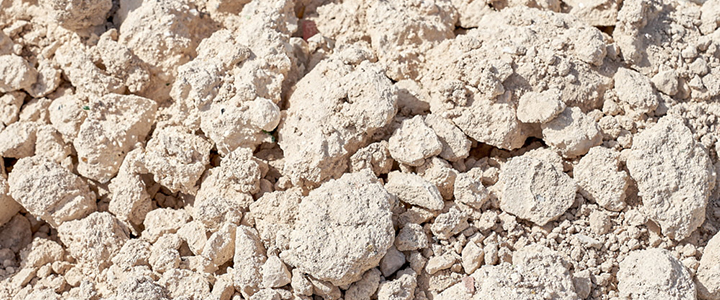
In midsummer, standing in an albariza vineyard of the Marco de Jerez, the ground can be almost painful to look at. The soil has baked under the Andalusian sun to a near-brilliant white, so reflective that it throws light back towards the vine canopy. This is albariza, and its whiteness is not decorative. It is functional. The colour comes from the calcareous nature of the soil, and that same composition helps explain why the best vineyards of the region are where they are.
The title of this article uses “chalk” in the broad wine-language sense: a useful word for evoking whiteness, limestone and porosity. Strictly speaking, however, albariza is not chalk in the narrow geological sense. It is more accurately described as a white calcareous marl. That distinction matters because albariza is not valuable merely because it is pale or limestone-rich. It matters because it combines mineral composition, structure, water behaviour, low fertility and a long history of viticultural adaptation.
What albariza is
Albariza is a white marl of marine origin, formed from ancient sediments deposited when this part of Andalusia lay beneath the sea during the Oligocene. Its composition is dominated by calcium carbonate, together with clay and silica. The silica is associated with the fossilised remains of marine microorganisms such as diatoms and radiolarians, which help explain the soil’s fine texture and porosity.
The official description of the D.O. Jerez-Xérès-Sherry identifies albariza as the predominant vineyard bedrock of the region: a soft white marl, easy to work, capable of retaining humidity and favourable to deep root development. It also places normal calcium carbonate levels in the range of at least 25% to 40%, with clay and silica completing the essential structure of the soil.
Other soils exist in the Marco de Jerez. Barros are darker, lower-lying, more fertile soils with more clay, sand and organic matter. Arenas are sandier coastal soils, with lower limestone content. All three have a place in the region’s viticultural landscape, but albariza has long been regarded as the defining soil for the highest-quality Palomino destined for Sherry.
A soil built for a dry summer
The Marco de Jerez receives around 600 litres of rainfall per square metre in an average year. The figure is not extraordinarily low by European standards, but the distribution is decisive. Rain falls mainly in the cooler months, while the active growing season is marked by long, bright, hot and dry conditions. The region also receives more than 300 days of sunshine a year, and the vineyard is shaped by the alternating influence of the Levante, the dry, warm wind from inland, and the Poniente, the humid Atlantic wind that moderates summer conditions.
Albariza is valuable because of how it manages that climate. During winter rains, the soil absorbs water and stores it at depth. As temperatures rise and the surface dries, the upper layer hardens into a pale crust that reduces evaporation. The vine’s roots, encouraged by the depth and structure of the soil, can explore the subsoil for reserves of moisture through the dry months.
Routine irrigation is therefore not part of the classical viticultural logic of Jerez. The current specifications of the D.O. allow vineyard irrigation only in exceptional circumstances or where the survival of the vines is at risk, and always under the authorisation and control of the Consejo Regulador. In normal conditions, albariza itself is expected to do the essential work of water storage and release.
Water, light and controlled vigour
The vine on albariza is not comfortably irrigated. Nor is it simply abandoned to drought. It lives within a controlled stress regime: enough water to continue its cycle, not enough to encourage excessive vigour. This balance is one of the keys to quality. Low fertility, limited organic matter and moderated water availability reduce vegetative growth and help concentrate the crop.
The whiteness of albariza adds another dimension. Its reflective surface increases light within the vine environment and helps moderate the immediate temperature around the plant. The effect should not be understood simplistically as “heating the bunches from below”. Albariza works through regulation: it reflects light, stores water, limits vigour, supports root depth and allows Palomino to ripen under demanding summer conditions while retaining the tension required for biologically aged wines.
This is especially important for Palomino. The grape is often described as neutral, but in Jerez that neutrality is not a weakness. On the contrary, Palomino’s restrained aromatic profile allows soil, biological ageing, oxidative development and cellar practice to become unusually legible in the final wine.
The human response: aserpiado
The importance of albariza is not only geological. It is also agricultural. Generations of growers developed vineyard practices designed to make the most of winter rainfall and reduce summer water loss. The best-known of these practices is aserpiado, in which the soil is shaped into small ridges and channels after the harvest. These serpentine forms slow the movement of rainwater, reduce erosion and encourage water to penetrate the albariza rather than running off the slope.
Aserpiado is a reminder that terroir in Jerez is not a passive idea. The soil matters, but so does the way people have learned to work with it. The vineyards of the Marco are the result of a long negotiation between climate, soil, grape variety and human practice.
Not one albariza, but many
Albariza should not be treated as a single uniform soil. Traditional local vocabulary distinguishes several expressions or subtypes, including tosca de barajuelas, tosca cerrada and lentejuelas. Tosca de barajuelas is noted for its layered structure; tosca cerrada is more compact; lentejuelas is associated with small shiny inclusions and textural variation.
These distinctions influence root penetration, water behaviour, vigour and the development of the grape. Growers who farm across different pagos often describe corresponding differences in must character: greater breadth in one site, more delicacy in another, stronger chalk-marked tension elsewhere. Such relationships should not be reduced to simple formulas. Soil subtype matters, but it interacts with slope, exposure, altitude, vine age, pruning, yield, harvest date, fermentation, fortification and ageing.
The pagos of the Marco de Jerez
The importance of albariza is inseparable from the idea of the pago. In the Marco de Jerez, a pago is a recognised viticultural area whose soils, orientation, altitude, orography and microclimate give its grapes a differentiated identity. It is not always equivalent to a single vineyard in the Burgundian sense. A pago may contain several viñas, but it expresses a shared set of conditions.
This vocabulary is old. References to the quality and particularity of the pagos appear in historical sources from at least the eighteenth century, and nineteenth-century authors such as Diego Parada y Barreto helped record the relationship between vineyard origin, grape quality and wine character. The modern Consejo Regulador completed the official map of pagos in 2015. Today, recognised pago names may be used on labels when traceability is guaranteed and at least 85% of the grapes come from the named pago.
For Jerez de la Frontera, Macharnudo remains the most celebrated name. Its prestige comes not from one factor alone, but from a combination of albariza, elevation, gentle slopes, exposure and Atlantic influence. Carrascal and Añina are also central to the historic geography of Jerez. For Sanlúcar de Barrameda, Miraflores is one of the emblematic pagos, often associated with finesse and maritime delicacy. For El Puerto de Santa María, Balbaína and Los Tercios are among the key names, their stronger Atlantic influence helping to shape a profile that sits between inland density and coastal freshness.
The official category of Jerez Superior should also be understood with precision. It is not merely a romantic synonym for “the best albariza”. It is a classification of vineyards whose agrogeological and climatic characteristics make them suitable for producing grapes of superior quality for the protected wines, with qualification overseen by the Consejo Regulador.
Why terroir is less visible in Sherry
The Marco de Jerez is one of the world’s great wine regions, yet vineyard-level discussion has historically been less visible here than in Burgundy, Barolo or the Mosel. The reason is structural. Sherry is not built around the release of a single vintage from a single parcel. It is built around classification, fortification, flor, oxidative development, dynamic ageing and the solera system.
Many bodegas have also depended, wholly or partly, on grapes or base wines supplied by growers and cooperatives. In that context, the identity of a wine has often been expressed through the solera, the bodega and the house style rather than through a named vineyard. The solera system itself tends towards continuity. It is designed to preserve a recognisable character over time, not to isolate the exact personality of a single harvest.
But this does not mean that terroir is absent. It means that terroir has often been less explicit. Soil and pago influence the must that enters the system. The solera then transforms, blends and lengthens that origin through time. In a great Sherry, site is not erased; it is absorbed into a broader architecture of biological or oxidative ageing.
The return of the vineyard
The renewed interest in pagos, old vineyard names, unfortified Palomino, en rama bottlings and specific solera selections has restored a missing layer of conversation. It does not reject the classical Sherry tradition. It enriches it. The modern language of site allows growers, bodegas and drinkers to ask more precise questions about why one Fino feels sharper, why one Manzanilla seems more delicate, why one Oloroso carries greater breadth or why a particular Palomino must has the structure to age.
This renewed attention to the vineyard also helps correct a common misunderstanding. Sherry is often presented only as a cellar wine, as if flor and solera alone explained everything. They explain a great deal, but not everything. The cellar can only transform what the vineyard gives it.
Why chalk matters
Albariza is not the whole explanation for Sherry. Flor, fortification, classification, criaderas and solera, cask age, cellar humidity, air flow and the decisions of the cellar master are all essential. But albariza is the beginning of the explanation. It is the physical condition that allows Palomino to grow, ripen and retain balance in a landscape of intense sunlight, dry summers and Atlantic winds.
The soil has always mattered. The historic language of pagos, the recognition of Jerez Superior vineyards and the renewed interest in origin all point to the same truth: Sherry is not only a cellar wine. It is also a vineyard wine. Understanding albariza is therefore the first step towards understanding why the wines of the Marco de Jerez taste as they do — not despite the solera system, but through it.