
Most bottles of Sherry do not carry a vintage. Not because the producers lack precision, but because, in most cases, a vintage date would misrepresent what the wine actually is. A Fino, Manzanilla, Amontillado, Oloroso, Palo Cortado, Cream, Moscatel or Pedro Ximénez aged through the traditional system of criaderas and solera is not the wine of one harvest. It is the result of fractional blending across time.
That qualification matters. Vintage Sherry exists. The D.O. Jerez-Xérès-Sherry allows wines to be aged by añada, separately from other harvests, under specific controls. But añada wines are the exception. The dominant grammar of Sherry is not the single year. It is continuity: the gradual integration of younger wine into older wine, the renewal of biological or oxidative ageing systems, and the preservation of a recognisable house character through repeated sacas and rocíos.
Understanding the solera system changes how you read a label, how you interpret an age statement, and how you think about consistency in wine. It also prevents one of the most common mistakes made by newcomers to Sherry: confusing a solera date with a vintage.
The architecture of the solera
The system has two main elements: the solera and the criaderas. The solera – from suelo, floor – is the final scale of ageing, the one from which wine is drawn for bottling or for later blending. The criaderas are the intermediate scales, each containing wine at a younger stage of development. In traditional cellar language, they are the nurseries that feed the solera.
The number of criaderas is not fixed. It depends on the wine, the bodega, the desired average age and the rhythm of the sacas. A young Fino may move through a relatively simple system; a more complex biological wine may pass through a deeper one. Oxidative wines often follow a different tempo. What matters is not the physical height of the casks, but the hierarchy of age: younger wine refreshes older wine, and the oldest scale is the one from which the final wine is drawn.
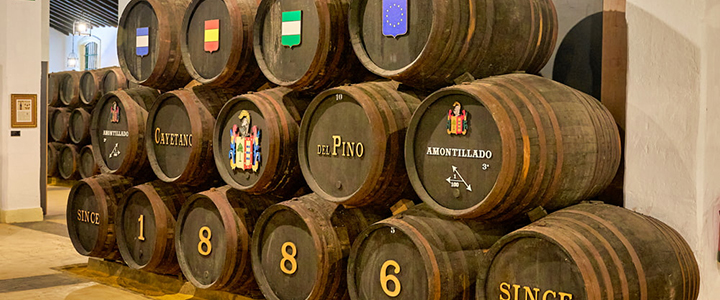
The casks are botas. The traditional bota bodeguera is generally made of American oak and has a capacity of around 600 litres, although the official framework permits oak casks up to 1,000 litres and allows certain historical exceptions under Consejo Regulador control. In practice, botas used for biological ageing are not filled completely: a free surface is left inside the cask, allowing the veil of flor to develop on the wine. In oxidative ageing, where the wine ages without flor, oxygen contact becomes part of the wine’s slow development.
How the system moves
The movement of wine through the system is based on two complementary operations. The saca is the extraction: a portion of wine is drawn from the solera. The rocío is the replenishment: the wine removed from that oldest scale is replaced with wine from the first criadera. The first criadera is then refreshed from the second, and so on, until the youngest scale receives new wine that has completed its initial classification and period as sobretabla.
This process is known as correr las escalas – running the scales. No bota is emptied completely. No scale is replaced all at once. The system works by partial movement and gradual integration. Each saca contains wine from different points in the life of the system, but the proportions are never equal. Younger wine enters slowly; older wine moderates it; time, oxygen, flor and the cellar environment reshape the blend.
This is why the solera should not be imagined as a static pyramid of barrels, nor as a museum preserving untouched wine from the year it was founded. It is a living mechanism. A solera date on a label indicates the historical origin or foundation of the system, not the harvest year of the wine in the bottle. The original wine, if any remains at all in a literal sense, would be present only as a vanishingly small fraction after generations of sacas and rocíos. What persists is not a measurable vintage component, but a continuous style.
Average age, not exact age
Age in Sherry must be understood differently from age in most still wines. In a solera wine, the relevant figure is the average age of the blend. The youngest wine is younger than that figure; some components are older. The label, when it makes a certified age claim, is not telling you the age of every molecule in the bottle. It is describing the average age of the wine as a whole.
This is not a weakness of the system. It is one of its strengths. A vintage date would suggest a single harvest. A solera wine is a regulated continuum. Its identity comes from the relation between total stocks, annual withdrawals, the depth of the ageing system and the bodega’s own discipline in maintaining it.
The official calculation is deliberately operational rather than romantic. In the current Pliego de Condiciones, average age is defined as t = Vt / Ve: total volume of wine in the ageing system divided by the total volume extracted for commercialisation during one year. This is why age in Sherry is inseparable from stock management. If too much is drawn, average age falls. If the system is maintained with restraint, average age and character are preserved.
Minimum ageing and certified age
The current rules require protected generoso wines to have a minimum average ageing of two years. In practice, many wines exceed that minimum substantially, especially serious Finos, Manzanillas Pasadas, Amontillados, Olorosos and Palo Cortados.
Certified age indications are more demanding. The Consejo Regulador recognises wines of more than 12 years and more than 15 years, and the two great old-wine categories: VOS and VORS. VOS stands for Vinum Optimum Signatum, commonly associated with Very Old Sherry, and applies to wines with an average age of more than 20 years. VORS stands for Vinum Optimum Rare Signatum, commonly associated with Very Old Rare Sherry, and applies to wines with an average age of more than 30 years.
These terms are not decorative. They require evidence, control and tasting. For wines of more than 20 years, the bodega must have at least twenty litres in crianza for every litre released. For wines of more than 30 years, it must have at least thirty litres in crianza for every litre released. This stock discipline prevents old soleras from being overdrawn and helps protect the meaning of the certification.
It is therefore incorrect to treat every producer-declared age as if it were an official certification. A wine described by a bodega as “around 20 years old” is not automatically VOS. A wine drawn from an old solera is not automatically VORS. The certification belongs to controlled categories and, in the case of the oldest wines, to specific certified sacas.
The important exception: Añada Sherry
The phrase “Sherry has no vintage” is useful shorthand, but it is not technically complete. The D.O. also permits ageing by añadas. In that system, wines from a single harvest are aged separately, without being blended with wines from other years.
Añada Sherry is therefore the exception that proves the rule. It exists, it is regulated, and it may carry a vintage year. But it belongs to a different logic. It is a static system, whereas criaderas and solera are dynamic. In añada wines, the vessel is sealed and controlled so that the wine can be traced to a single harvest. The regulations also require that, when an añada wine states the harvest year, the year of bottling must also appear.
This distinction matters because it prevents an over-simplification. Most Sherry is not vintage wine because most Sherry is aged through a dynamic system of fractional blending. Vintage Sherry exists, but it is a separate and comparatively rare category.
Why the system exists
The solera system did not emerge from theory. It developed from practice. Jerez was an export region, and wines had to travel. Blending younger wines with older wines helped moderate harvest variation, improve reliability and create a product that could be recognised by merchants and drinkers across distant markets. The late eighteenth century was a decisive period in the development of the system and of the bodega architecture that made the modern Sherry industry possible.
Over time, what began as a practical solution became one of the defining cultural and technical features of the region. The system was particularly important for biological ageing, because flor needs renewal. Young wine brings nutrients. Periodic rocíos help keep the veil alive. Without movement, biological ageing would eventually exhaust itself. Oxidative wines benefit differently: they gain from gradual concentration, slow oxygen exposure and the moderating influence of older wine.
The system therefore serves several purposes at once. It creates continuity from year to year. It integrates harvest variation. It supports biological ageing. It gives the bodega a practical way to maintain house style. And, at its best, it produces a form of complexity that no single vintage could easily reproduce.
Consistency without uniformity
The consistency produced by criaderas and solera should not be confused with industrial uniformity. A classical Fino or Manzanilla is recognisable because the system preserves a house character, but each saca may still show nuance. Flor is alive. Temperature, humidity, seasonal rhythm, the condition of the yeast and the character of the young wine entering the system all influence the final expression.
This is particularly evident in seasonal sacas and in many en rama bottlings, where differences in texture, intensity, flor character and freshness can be perceptible. The wine remains recognisable, but it is not inert. The solera gives continuity; the cellar gives life.
For oxidative wines, the same principle applies in another register. An Oloroso or Palo Cortado may be shaped less by flor and more by oxygen, concentration and the slow exchange between wine, wood and air. But the dynamic system still matters. The older wine disciplines the younger wine, and the younger wine prevents the system from becoming static, exhausted or excessively concentrated.
What a solera date really means
A date printed on a Sherry label can easily mislead the unprepared reader. González Byass Solera 1847, for example, is not an 1847 vintage wine. The date refers to the foundation or historical identity of the solera, not to the harvest year of the wine in the bottle.
This does not make the date meaningless. It makes it different. A solera date points to continuity: to the long operation of a system, the preservation of a style, the memory of a bodega and the accumulated effect of countless sacas and rocíos. It is a historical claim, not a vintage claim.
The current rules recognise this distinction. References to the year of foundation of a solera or of a bodega may be used when they can be documented and when they do not create confusion. That final condition is essential: a solera date should illuminate history, not pretend to be a harvest year.
How to read the label
A Sherry label should therefore be read with different expectations. If the wine is a standard Fino, Manzanilla, Amontillado, Oloroso, Palo Cortado, Cream, Moscatel or Pedro Ximénez, it is normally a non-vintage wine from a system of criaderas and solera. If it carries an age indication such as 12 years, 15 years, VOS or VORS, that age refers to an average age under the relevant certification rules. If it carries a solera date, that is not a vintage. If it is labelled as an añada, then it belongs to the separate category of vintage Sherry.
The most important lesson is simple: Sherry is not less precise because it usually has no vintage. It is precise in another way. Its grammar is not the grammar of harvest year alone. It is the grammar of average age, dynamic ageing, biological or oxidative development, house style and time made continuous.
That is why the solera system remains central to understanding the wines of Jerez. It does not erase origin, age or history. It reorganises them. It turns the isolated year into a sequence, the single cask into a system, and the bottle into the visible result of an invisible chain of renewal.